

Tax Tip Tuesday: Business Mileage Deduction: How to Track and Deduct Your Business Miles
The Business Mileage Deduction can be valuable for self-employed taxpayers and business owners who regularly use a personal vehicle for work. But simply driving your vehicle for business isn’t enough. You also need records showing which miles were for business and which were personal.
Keeping an accurate mileage log throughout the year can help support your Business Mileage Deduction and make tax preparation much easier.
Business owners generally have two ways to calculate deductible vehicle costs: the standard mileage rate or the actual expense method. For 2025, the IRS standard mileage rate for business use was 70 cents per mile. For 2026, different rates apply depending on when the business miles were driven.
Here’s what business owners should know about tracking mileage and claiming a Business Mileage Deduction.
How Does the Business Mileage Deduction Work?
The Business Mileage Deduction allows eligible taxpayers to account for qualifying vehicle use when calculating business expenses. The deduction is generally calculated using either the IRS standard mileage rate or the business portion of actual vehicle expenses.
Under the standard mileage method, qualifying business miles are multiplied by the applicable IRS rate. Under the actual expense method, taxpayers generally determine the business-use percentage of eligible vehicle expenses.
In either case, accurate mileage records are important because your vehicle may be used for both business and personal purposes.
Your mileage records should provide enough information to establish the business use of your vehicle.
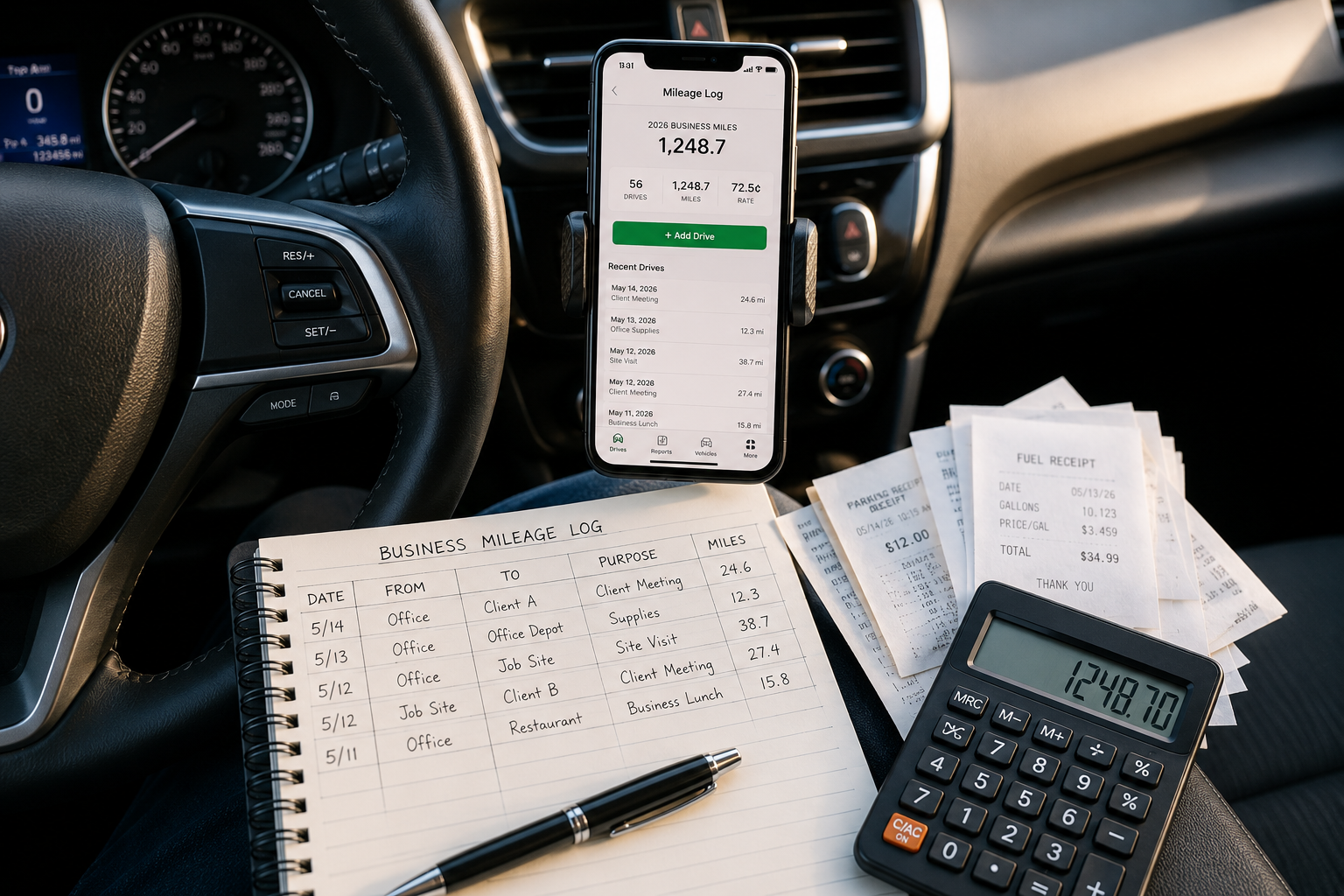
A useful Business Mileage Log should generally document information such as:
- Date of the trip
- Starting point and destination
- Number of business miles driven
- Business purpose of the trip
- Total mileage information needed to establish business versus personal use
You can maintain these records using a paper mileage book, spreadsheet, accounting system, or mileage-tracking app.
The specific system matters less than consistency.
Recording a trip immediately is much easier than trying to remember where you drove six months later.
What Driving Qualifies for the Business Mileage Deduction?
Self-employed taxpayers may have two potential ways to calculate qualifying vehicle expenses.
What Should You Include in Your Mileage Log?
The standard mileage method uses an IRS-established rate multiplied by your qualifying business miles.
For example, if you drove 10,000 qualifying business miles during 2025, multiplying those miles by the 70-cent rate would produce a potential mileage-based amount of $7,000, before considering applicable rules and limitations.
The standard mileage rate is designed to account for vehicle operating costs. If you use it, you generally don’t separately deduct items such as gasoline, depreciation, insurance, maintenance, repairs, registration fees, and lease payments for that same vehicle use.
Certain business-related parking fees and tolls may generally be deductible separately.
Business Mileage Deduction Using Actual Vehicle Expenses
Instead of using the standard mileage rate, eligible taxpayers may calculate the business portion of their actual vehicle expenses.
Those expenses can potentially include:
- Gas and oil
- Repairs
- Maintenance
- Insurance
- Registration fees
- Tires
- Depreciation
- Lease payments, when applicable
If your vehicle is used for both business and personal purposes, only the qualifying business portion is deductible.
That means mileage records are still important even when you choose actual expenses because you need a reasonable way to establish the percentage of vehicle use attributable to business.
What Is the 2026 Business Mileage Rate?
If you’re preparing or reviewing a 2025 tax return, the applicable business standard mileage rate is 70 cents per qualifying business mile.
But don’t use that number for current 2026 mileage.
The IRS initially established a 2026 business rate of 72.5 cents per mile. Due to increased fuel prices, the IRS subsequently revised the rate to 76 cents per mile for qualifying business mileage beginning July 1, 2026.
For taxpayers keeping a Business Mileage Log during 2026, that means the date of each trip is particularly important because two different rates apply during the year.
Can You Deduct Your Daily Commute?
One of the biggest mistakes taxpayers make is assuming that any driving connected with work counts as deductible mileage.
Commuting generally doesn’t.
Driving from your home to your regular workplace and back is typically considered personal commuting, regardless of how far you travel.
Business transportation can be different.
For example, traveling from your regular business location to meet a client or driving between qualifying work locations during the day may potentially constitute business mileage.
There are additional rules involving temporary work locations and taxpayers with qualifying home offices, so the facts surrounding a particular trip can matter.
Our Home Office Deduction article provides additional information for self-employed taxpayers who operate a business from a qualifying portion of their home.
Can You Switch Between Mileage and Actual Expenses?
Sometimes—but there are rules.
For an owned vehicle, taxpayers who want the flexibility to use the standard mileage method generally must choose the standard mileage rate in the first year the vehicle is available for business use. In later years, they may be able to switch between methods, subject to applicable rules.
For a leased vehicle, choosing the standard mileage rate generally means using that method throughout the entire lease period, including renewals.
This is one reason it’s worth considering both methods before making a decision.
The easiest calculation isn’t necessarily the one that produces the best tax result.
Mileage Records Can Help Protect Your Business Mileage Deduction
Accurate vehicle records are part of good overall business recordkeeping.
The same discipline that helps document mileage can also strengthen your records for Business Travel Expenses, Business Expense Deductions, and other costs associated with operating your business.
Keep receipts.
Track expenses when they occur.
Record the purpose of business trips.
And keep business and personal activity clearly separated.
At Cheshier Tax Resolution, we encourage self-employed taxpayers and business owners to make recordkeeping part of their regular routine rather than something they try to recreate at filing time.
Business Mileage Log: The Bottom Line
A Business Mileage Log is one of the simplest tools available to self-employed taxpayers who use a vehicle for business.
You don’t need an elaborate system.
You need a consistent one.
Document your business miles, record why each trip was business related, keep supporting records, and understand whether the standard mileage rate or actual expense method is appropriate for your situation.
A few minutes of recordkeeping today can save hours of searching—and potentially protect a valuable deduction—when it’s time to prepare your tax return.
Frequently Asked Questions
What should I include in a Business Mileage Log?
Keep records showing when you drove, where you traveled, how many business miles you drove, and the business purpose of the trip. You should also maintain sufficient records to distinguish business use from personal vehicle use.
What was the business mileage rate for 2025?
The IRS standard mileage rate for qualifying business use in 2025 was 70 cents per mile.
What is the business mileage rate for 2026?
The rate is 72.5 cents per mile for January 1 through June 30, 2026, and 76 cents per mile for qualifying business mileage beginning July 1, 2026.
Can I deduct my commute to work?
Generally, no. Regular commuting between your residence and regular workplace is generally considered personal rather than deductible business mileage.
Is actual vehicle expense better than standard mileage?
It depends. The actual-expense method may produce a larger deduction in some circumstances, while the standard mileage method can be simpler. Your vehicle costs, business-use percentage, mileage, and applicable tax rules should all be considered.
Stay Connected
Stay connected with Cheshier Tax Resolution for updates on community involvement, tax law changes, and insights that help taxpayers stay compliant and informed – we invite you to subscribe to our monthly newsletter.
Our newsletter delivers:
- Updates on tax law changes
- Insights from real resolution cases
- Proactive planning strategies
- Important filing deadlines and compliance reminders
- Company announcements and celebrations