

Tax Tip Tuesday: 7 Essential Tax Tips
Giving to a charitable organization can make a meaningful difference in your community. But when tax season arrives, will you have the documentation needed to claim your donation?
Charitable Contribution Deductions can help eligible taxpayers reduce taxable income, but the IRS has specific rules about which donations qualify and what records you must keep.
Whether you donate money, clothing, household goods, or other property, good recordkeeping matters. And beginning with the 2026 tax year, new deduction rules make understanding charitable giving even more important.
Here are seven essential tax tips to help protect your charitable contribution deductions.
1. Keep Records of Every Charitable Donation
One of the biggest mistakes taxpayers make is assuming small donations do not require documentation.
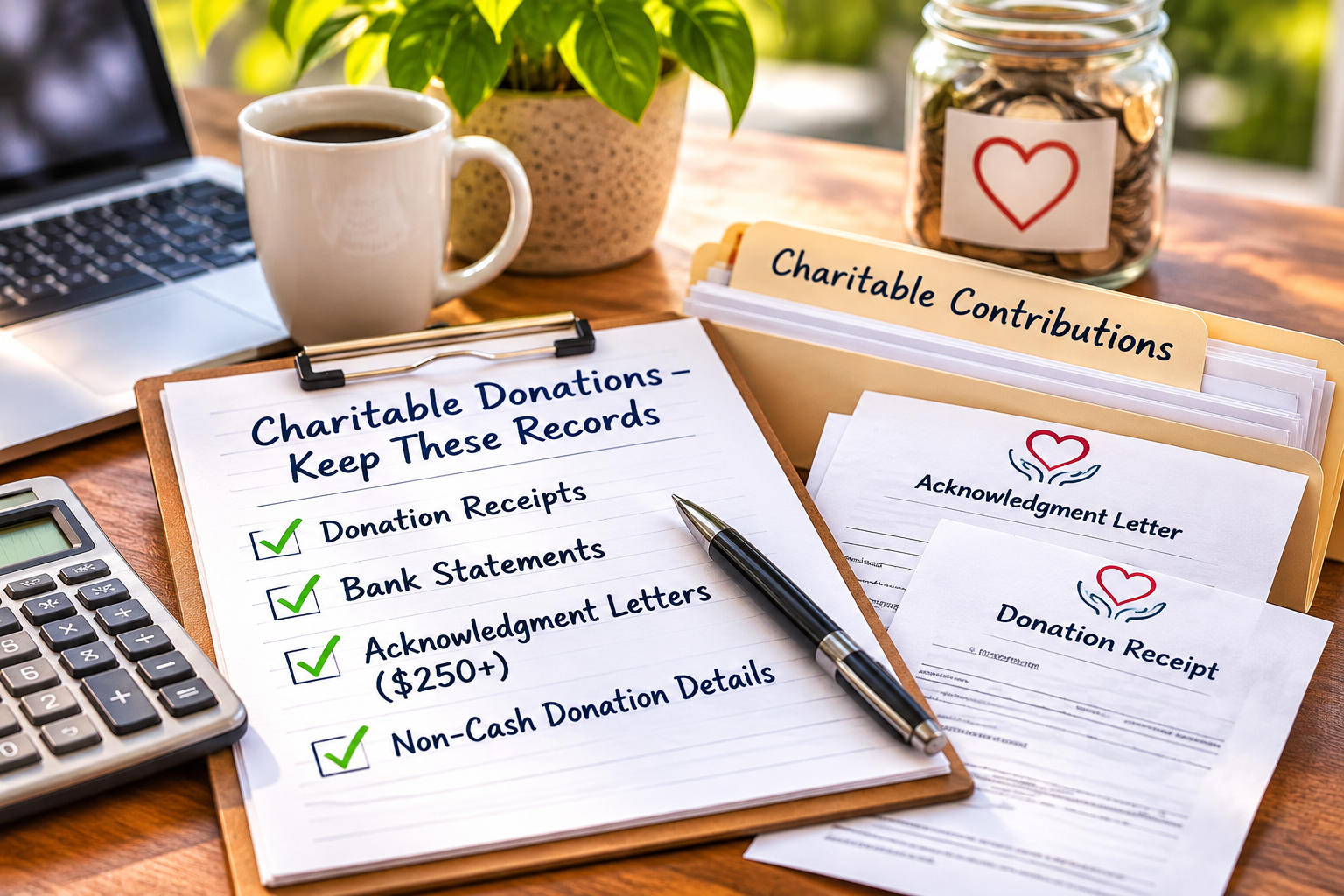
The IRS requires records for cash contributions, regardless of the amount. Acceptable documentation generally includes a bank record or written communication from the charity showing the organization’s name, donation date, and amount contributed.
Bank statements, canceled checks, and qualifying donation receipts can help establish this information. For electronic donations, save confirmation emails and payment records.
Charitable Contribution Deductions are much easier to support when documentation is collected throughout the year rather than reconstructed during tax season.
IRS guidance: Tips for tracking charitable donations
2. Donations of $250 or More Require Written Acknowledgment
This is one of the most important charitable donation rules to remember. For any single charitable contribution of $250 or more, the IRS generally requires a contemporaneous written acknowledgment from the qualified organization.
That acknowledgment must identify the organization and include the amount of a cash donation or a description of donated property. It must also state whether the organization provided goods or services in exchange for the contribution and include additional details when applicable.
A bank statement alone generally is not sufficient for a donation meeting this threshold. The acknowledgment must be obtained by the earlier of the date you file your return or the filing deadline, including extensions.
The $250 threshold applies to individual contributions. Separate smaller donations generally are not combined to determine whether this particular acknowledgment requirement applies.
3. Document Noncash Charitable Contributions
Not every charitable donation involves money. Clothing, furniture, household goods, and other property may qualify for Charitable Contribution Deductions when donated to an eligible organization.
However, donating an item does not automatically mean you can deduct its original purchase price. Noncash contributions are generally valued using fair market value at the time of donation, subject to applicable rules.
Keep a detailed description of the items donated, their condition, the donation date, and how you determined their value. For clothing and household items, the IRS generally requires the items to be in good used condition or better, with limited exceptions.
If your total deduction for noncash contributions exceeds $500, you generally must complete IRS Form 8283. Certain higher-value donations may also require a qualified appraisal.
4. Understand the New 2026 Charitable Donation Deduction
Here is an important change for taxpayers who normally claim the standard deduction. Beginning with the 2026 tax year, eligible taxpayers who do not itemize may deduct up to $1,000 in qualifying cash contributions, or up to $2,000 for married couples filing jointly.
This deduction applies to qualifying cash contributions made to certain eligible charitable organizations. Noncash donations do not qualify for this particular benefit.
For taxpayers who itemize, a separate new rule generally limits the deduction to qualifying charitable contributions exceeding 0.5% of adjusted gross income, subject to other applicable limits.
These changes make accurate documentation especially important when planning Charitable Contribution Deductions for 2026.
IRS guidance: Charitable contribution deduction for non-itemizers
5. Verify That the Charity Qualifies
Not every organization collecting donations qualifies for a federal charitable contribution deduction. Gifts made directly to individuals generally are not deductible as charitable contributions.
Before donating, verify the organization’s eligibility using the IRS Tax Exempt Organization Search. This is particularly important when supporting unfamiliar organizations, online fundraising campaigns, or newly established charities.
A good cause does not automatically mean the donation qualifies for a tax deduction.
IRS Tax Exempt Organization Search
6. Understand What Happens When You Receive Something in Return
Charitable fundraising dinners, auctions, and benefit events often involve payments that provide something of value in exchange.
If you receive a meal, merchandise, admission, or another benefit, you generally cannot deduct the full payment as a charitable contribution. Instead, the deductible amount may be limited to the portion exceeding the fair market value of what you received.
For example, if you pay $150 for a qualifying charity event ticket and receive a meal worth $50, the potentially deductible contribution may be $100.
Keep documentation showing the payment and the value of any benefits received. This distinction helps prevent overstating Charitable Contribution Deductions.
7. Organize Your Donation Records Before Tax Season
Waiting until filing season to locate donation receipts can lead to missing records and overlooked deductions.
Consider maintaining a dedicated digital folder for charitable contributions. Save donation confirmations, bank records, acknowledgment letters, and descriptions of noncash property. For larger donations, preserve any required valuation records and appraisals.
Our recent Tax Tip Tuesday coverage of tax record retention also explains why keeping supporting documentation is important when responding to IRS questions.
Charitable Contribution Deductions should be supported by reliable records, not estimates made months after the donation.
Frequently Asked Questions About Charitable Contribution Deductions
Do I need a receipt for charitable donations under $250?
You must maintain a qualifying bank record or written communication from the charity for cash donations of any amount. A formal acknowledgment letter is generally required for individual contributions of $250 or more.
Does a $250 charitable donation require a letter?
Yes. A single qualifying contribution of $250 or more generally requires a contemporaneous written acknowledgment from the charitable organization before you can claim the deduction.
Can I deduct donated clothing and household goods?
Potentially. Eligible noncash donations may be deductible if you meet the applicable requirements, including documentation, valuation, and condition rules.
Can I deduct charitable donations without itemizing in 2026?
Yes, if eligible. Beginning in 2026, qualifying taxpayers who do not itemize may deduct up to $1,000 in eligible cash contributions, or $2,000 for married couples filing jointly. Additional restrictions apply.
Are donations to GoFundMe or individuals tax deductible?
Generally, donations made directly to individuals are not deductible charitable contributions. Contributions through fundraising platforms may qualify only when the actual recipient and donation meet IRS requirements.
Charitable Contribution Deductions: The Bottom Line
Supporting charitable organizations is an important way to give back, but protecting your tax deduction requires more than generosity.
Keep records of every donation, obtain written acknowledgments for individual contributions of $250 or more, and understand the special requirements for noncash gifts.
With new charitable deduction rules taking effect in 2026, taxpayers have additional reasons to review their giving and documentation before year-end.
At Cheshier Tax Resolution, we believe informed taxpayers are better prepared to avoid filing errors and respond confidently when the IRS requests supporting documentation.
Good recordkeeping today can help protect your charitable contribution deductions tomorrow.
Stay Connected
Stay connected with Cheshier Tax Resolution for updates on community involvement, tax law changes, and insights that help taxpayers stay compliant and informed – we invite you to subscribe to our monthly newsletter.
Our newsletter delivers:
- Updates on tax law changes
- Insights from real resolution cases
- Proactive planning strategies
- Important filing deadlines and compliance reminders
- Company announcements and celebrations