

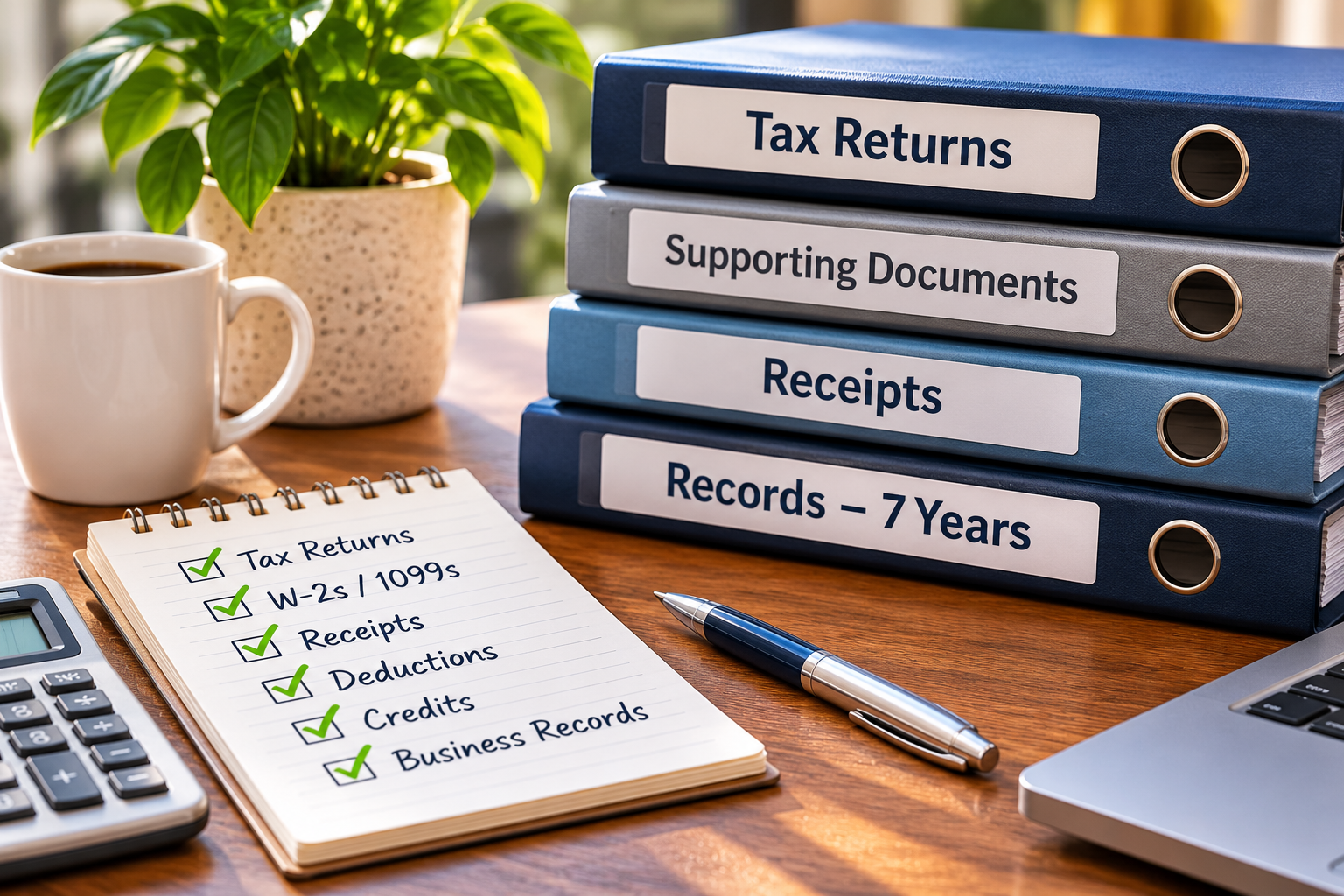
Tax Tip Tuesday: Tax Record Retention: 7 Essential Rules to Know
You filed your tax return. You received the acceptance confirmation. Maybe you even received your refund. Is it time to throw away the paperwork? Not so fast.
Tax Record Retention matters long after filing season ends. Copies of filed returns and the documents supporting them can help you answer IRS questions, prepare future returns, verify past payments, or correct an error.
You may have heard the advice to keep tax records for at least seven years. That can be a sensible personal policy, but it is not a universal IRS requirement. The right retention period depends on the record and your circumstances. Here are seven practical rules to follow.
1. Understand the Basic Tax Record Retention Rule
For many federal income tax returns, the general period for keeping supporting records is three years. The IRS explains that you should retain documents supporting income, deductions, and credits until the applicable period of limitations expires.
The timing matters: a return filed before its due date is generally treated as filed on the due date for these purposes. If you are claiming a credit or refund after filing, the applicable period is generally the later of three years after filing or two years after paying the tax. Review the IRS guidance on how long to keep records before deciding what to discard.
2. Know When Six or Seven Years May Be Required
Tax Record Retention is not always a three-year exercise. The IRS identifies a six-year period in certain cases involving substantial unreported income, including when omitted income exceeds 25% of the gross income shown on a return.
The seven-year rule specifically applies to records connected with a claim for a loss from worthless securities or a bad debt deduction. That is different from saying everyone must keep every tax receipt for seven years.
Keeping an organized seven-year archive may still be a reasonable conservative choice for many households, provided records that require longer retention are preserved.
3. Some Tax Records Need to Be Kept Much Longer
Do not automatically destroy property-related records after seven years. Documents establishing the cost basis of a home, rental property, or investments may be needed until the property is sold and the limitations period for that sale has expired.
Business owners may also need depreciation schedules and purchase records across multiple tax years. Employment tax records generally must be retained for at least four years after the tax becomes due or is paid, whichever is later.
For fraudulent returns or years when a required return was never filed, there may be no ordinary assessment time limit. Our article on IRS Substitute for Return issues explains why unresolved filing years can create lasting complications.
4. Save the Filed Return and Its Supporting Documents
A PDF of your Form 1040 is a good start, but complete Tax Record Retention means keeping the documents that explain the numbers on that return. Save the final filed return, schedules, Forms W-2 and 1099, K-1s, charitable contribution records, business receipts, mileage logs, and documentation for claimed credits.
Keep proof of estimated tax payments and any IRS correspondence. If you file electronically, save your IRS acceptance confirmation. If you mail a return, retain your mailing or delivery evidence.
For self-employed taxpayers, the importance of records is especially clear. Our Gig Economy Taxes guide discusses how income statements, expense records, and mileage documentation support accurate reporting.
5. Organize Your Tax Records by Year
An effective Tax Record Retention system does not have to be complicated. Create one secure folder for each tax year and use consistent subfolders for the filed return, income documents, deductions, payment confirmations, and IRS notices.
If you keep digital copies, use secure storage, strong passwords, and reliable backups. If you keep paper files, store them in a locked location protected from water and fire damage. Avoid sending Social Security numbers or complete tax returns through unsecured channels.
The goal is simple: when a question comes up years later, you should be able to locate the right document without reconstructing your entire financial history.
6. Keep Records for Audits, Corrections, and IRS Notices
Good Tax Record Retention is about more than preparing for an audit. Prior-year returns can help you prepare a new return, calculate carryovers, confirm your filing history, or prepare an amended return when appropriate.
If the IRS sends a notice, the supporting documents may be essential to understanding and responding to it. The IRS explains the value of organized records in Tax Topic 305: Recordkeeping.
You can also review account information through IRS transcripts. Cheshier Tax Resolution offers an IRS Transcript Monitoring Program that helps taxpayers stay informed about account activity. A transcript is useful, but it does not replace every supporting document from the original return.
7. Review Before You Shred or Delete
Before disposing of old tax documents, confirm that the relevant federal retention period has passed, no unresolved audit or claim requires them, and the records are not needed for property basis, business purposes, state tax rules, insurance, or lending.
When disposal is appropriate, shred paper records containing personal information and securely delete digital files. Do not simply place sensitive tax paperwork in the trash.
Tax Record Retention: The Bottom Line
Keeping copies of filed tax returns is one of the easiest ways to protect yourself from future confusion. A seven-year filing system can be a helpful rule of thumb, but the IRS generally applies different retention periods depending on the situation. Some documents should be kept longer.
At Cheshier Tax Resolution, we help taxpayers work through IRS filing, notice, and account issues. A well-organized tax history can make those conversations faster, clearer, and more productive.
The best time to organize your tax records is immediately after filing—while everything is still easy to find.
Frequently Asked Questions About Tax Record Retention
How long should I keep copies of filed tax returns?
The IRS generally recommends retaining returns and supporting records for at least three years in ordinary circumstances. Some situations require six years, seven years, or longer.
Does the IRS require everyone to keep tax records for seven years?
No. Seven years is specifically relevant to claims involving worthless securities or bad debt deductions. It may also be a useful conservative organizational policy, but it is not a universal legal requirement.
What tax records should I keep with my return?
Keep the filed return and schedules, income statements, receipts, records supporting deductions and credits, tax payment confirmations, and relevant IRS notices.
Can I keep digital copies of tax records?
Generally, yes. Maintain complete, readable, accessible files with secure storage and backups, and preserve any originals that are independently required.
How long should I keep records for a home or rental property?
Keep records establishing basis and improvements while they remain relevant, generally through the sale or disposition of the property and the applicable limitations period afterward.
Stay Connected
Stay connected with Cheshier Tax Resolution for updates on community involvement, tax law changes, and insights that help taxpayers stay compliant and informed – we invite you to subscribe to our monthly newsletter.
Our newsletter delivers:
- Updates on tax law changes
- Insights from real resolution cases
- Proactive planning strategies
- Important filing deadlines and compliance reminders
- Company announcements and celebrations