

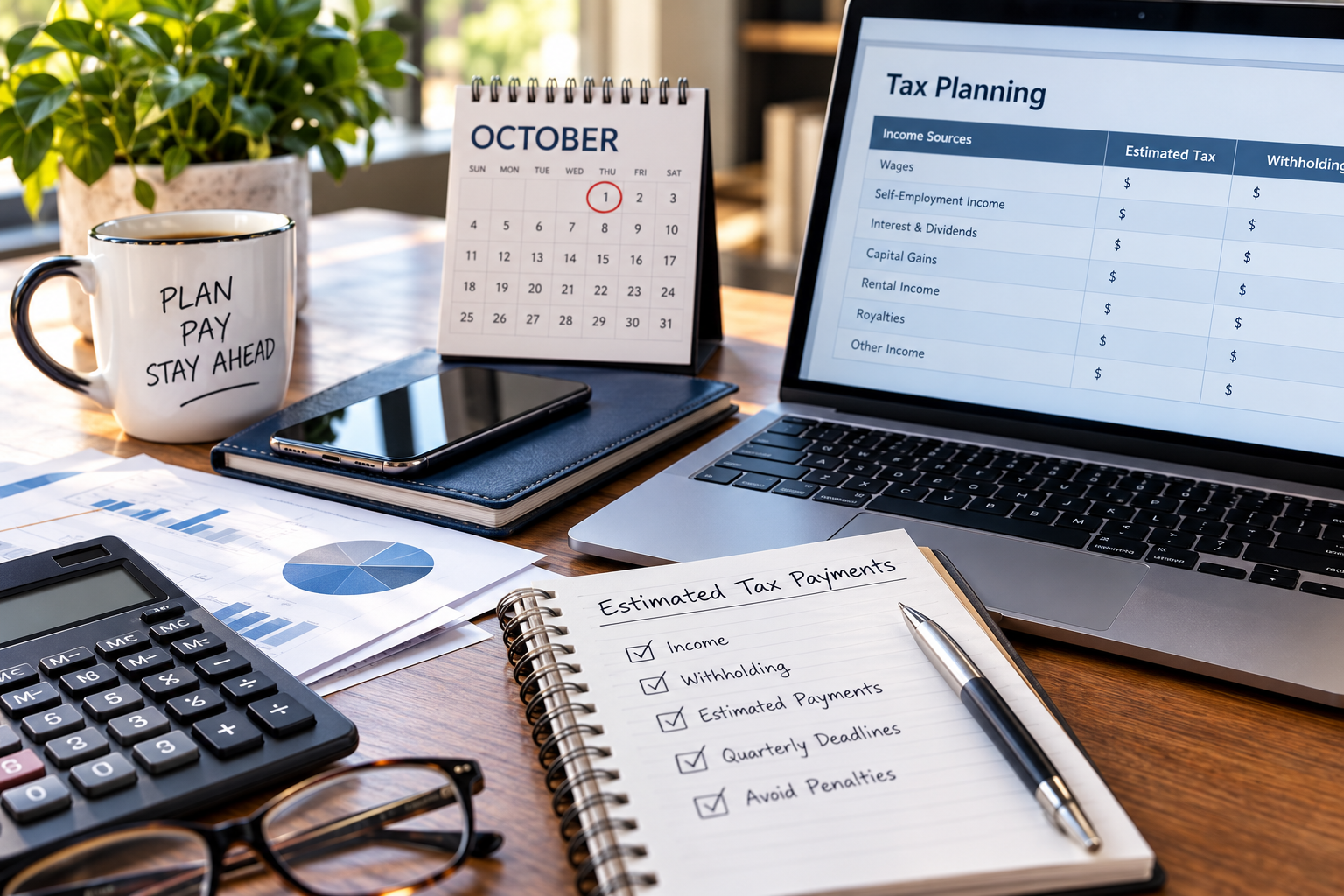
Estimated Tax Payments Aren’t Just for the Self-Employed
Estimated tax payments are often associated with freelancers, independent contractors and business owners, but the IRS recently reminded taxpayers that self-employed individuals aren’t the only people who may need to make them.
Federal income tax operates on a pay-as-you-go system. In other words, taxpayers generally need to pay tax as income is earned or received throughout the year rather than waiting until they file their tax return. Federal taxes are typically paid through withholding, estimated payments or a combination of both.
That means someone with a traditional W-2 job could still need to make estimated payments if they receive substantial income from other sources or don’t have enough federal tax withheld.
Understanding the rules before tax season can help taxpayers avoid an unexpected balance due—and potentially an underpayment penalty.
1. Estimated Tax Payments Aren’t Only for Business Owners
Self-employed taxpayers commonly make estimated tax payments because they generally don’t have an employer withholding federal income tax from their earnings.
But the same basic issue can affect someone who isn’t self-employed.
According to the IRS guidance on estimated taxes, taxpayers may need to make estimated payments when they receive income that isn’t subject to withholding or when the amount withheld from their income isn’t sufficient to cover their expected tax obligation.
This is why estimated taxes shouldn’t automatically be viewed as a “self-employment tax issue.” They are really a pay-as-you-go tax issue.
2. Several Types of Income Can Create an Estimated Tax Obligation
Income outside a regular paycheck can change a taxpayer’s tax picture.
The IRS identifies several types of income that may result in the need for estimated payments, including:
- Interest
- Dividends
- Capital gains
- Royalties
- Rental income
- Prizes and awards
- Certain alimony income
For example, someone may have sufficient withholding for the salary earned from their regular job but also receive investment income or rental income during the year.
Because tax may not automatically be withheld from those additional sources, the taxpayer’s existing paycheck withholding may no longer be enough.
3. The $1,000 Rule Is an Important Starting Point
So how do you know whether estimated tax payments may be required?
For individuals, including sole proprietors, partners and S corporation shareholders, one important threshold is whether the taxpayer expects to owe $1,000 or more when the tax return is filed.
However, the complete calculation is more nuanced than simply asking whether you’ll owe $1,000.
In general, estimated payments may be required when both of these conditions apply:
- You expect to owe at least $1,000 for the current tax year after subtracting withholding and refundable credits.
- Your withholding and refundable credits are expected to be less than the smaller of 90% of your current-year tax or generally 100% of the tax shown on your prior-year return.
For certain higher-income taxpayers, the prior-year percentage generally becomes 110%. Special rules can also apply in certain circumstances.
This is one reason taxpayers shouldn’t rely solely on a simple dollar threshold when deciding whether they need to make payments.
4. Estimated Taxes Can Cover More Than Income Tax
Another common misconception is that estimated payments are only about federal income tax.
They can also be used to cover other tax obligations, including self-employment tax and alternative minimum tax.
For someone with multiple income sources, that can make estimating the year’s overall tax liability more complicated.
A change in business income, investment activity, rental income or other taxable income can alter how much tax should be paid throughout the year.
That’s why reviewing your tax situation during the year can be more useful than discovering the problem when your return is prepared.
5. Estimated Tax Payments Don’t Have to Be Made Only Four Times a Year
Estimated taxes are commonly called quarterly estimated taxes, but taxpayers aren’t limited to making payments only four times per year.
Payments can be made weekly, biweekly, monthly or on another schedule, provided enough has been paid by the applicable quarterly deadline.
That flexibility can be helpful for taxpayers whose income isn’t consistent throughout the year.
For example, a taxpayer who receives irregular income may find it easier to set aside and submit tax payments as income arrives rather than waiting to make a larger payment later.
The key is making sure the required amount has been paid by the applicable deadline.
6. There Are Several Ways to Pay Estimated Taxes
The IRS provides multiple options for making estimated tax payments.
Individuals can make payments online, by phone or by mail using Form 1040-ES. Taxpayers can also use their IRS Individual Online Account, which provides access to payment history and other tax information.
Businesses can make many common federal tax payments through an IRS Business Tax Account or Direct Pay for businesses.
Taxpayers can review available payment methods at the IRS Payments website.
Those looking for more detailed information can also consult IRS Publication 505, Tax Withholding and Estimated Tax, which provides additional guidance about estimated tax calculations, withholding and special rules.
7. Not Paying Enough During the Year Can Lead to a Penalty
Waiting until tax season to pay everything owed isn’t always enough to avoid additional cost.
Because the federal tax system is pay-as-you-go, taxpayers who don’t pay enough during the year through withholding and/or estimated tax payments may face an underpayment penalty.
That can happen even if the taxpayer ultimately pays the entire balance when filing the return.
This makes proactive tax planning especially important when your financial situation changes during the year.
It may be time to review your withholding or estimated payments after events such as:
- Starting a side business
- Receiving significant investment income
- Selling investments or other assets at a gain
- Beginning to receive rental income
- Experiencing a substantial increase in business income
- Receiving a large prize or award
- Having multiple sources of household income
Employees may also have another option. Wage earners may be able to reduce or eliminate the need for separate estimated payments by submitting a new Form W-4 to their employer and increasing the amount withheld from their paycheck. We have a life stage checklist that can be helpful in deciding when and if one should update their W-4.
Don’t Wait Until Tax Season to Review Your Tax Situation
With the new business travel per diem rates effective October 1, this is a good time for The biggest lesson from the IRS reminder is simple: estimated tax payments aren’t just for the self-employed.
Any taxpayer receiving income that isn’t adequately covered by withholding should consider whether enough federal tax is being paid throughout the year.
The goal isn’t necessarily to predict your final tax return down to the dollar months in advance. It’s to recognize when your income or withholding situation has changed enough that your current payments may no longer be sufficient.
At Cheshier Tax Resolution, we encourage taxpayers and business owners to look at their tax situation throughout the year rather than waiting until filing season to discover an unexpected balance.
If you’ve added a new income source, experienced a significant change in earnings or consistently owe money when filing your return, it may be time to review your withholding and estimated tax payments.
Frequently Asked Questions About Estimated Tax Payments
Who needs to make estimated tax payments?
Self-employed individuals commonly make estimated payments, but other taxpayers may need them as well. Income from interest, dividends, capital gains, rents, royalties, prizes and other sources not adequately covered by withholding can create a need for estimated payments.
Do I need estimated tax payments if I have a regular job?
Possibly. Having taxes withheld from wages doesn’t automatically mean enough is being paid to cover tax attributable to your other income. Some employees can increase withholding through Form W-4 instead of making separate estimated payments.
How much can I owe before estimated payments may be required?
Individuals generally begin by considering whether they expect to owe at least $1,000 after subtracting applicable withholding and credits. Additional IRS percentage tests determine whether estimated payments are required.
Are estimated taxes always paid quarterly?
No. Although quarterly payments are common, taxpayers may make payments more frequently as long as enough is paid by the applicable quarterly deadline.
Can I be penalized even if I pay my entire tax bill when I file?
Potentially, yes. A taxpayer who didn’t pay enough throughout the year through withholding and estimated payments may owe an underpayment penalty because federal income tax is a pay-as-you-go system.
Where can I learn more about estimated taxes?
The IRS provides detailed information through Publication 505, Tax Withholding and Estimated Tax, Form 1040-ES, and its online Estimated Taxes resources.
Stay Connected!
Stay connected with Cheshier Tax Resolution for updates on community involvement, tax law changes, and insights that help taxpayers stay compliant and informed – we invite you to subscribe to our monthly newsletter.
Our newsletter delivers:
- Updates on tax law changes
- Insights from real resolution cases
- Proactive planning strategies
- Important filing deadlines and compliance reminders
- Company announcements and celebrations