
Tax Tip Tuesday: Qualified Business Income Deduction: A Powerful Tax Break for Business Owners
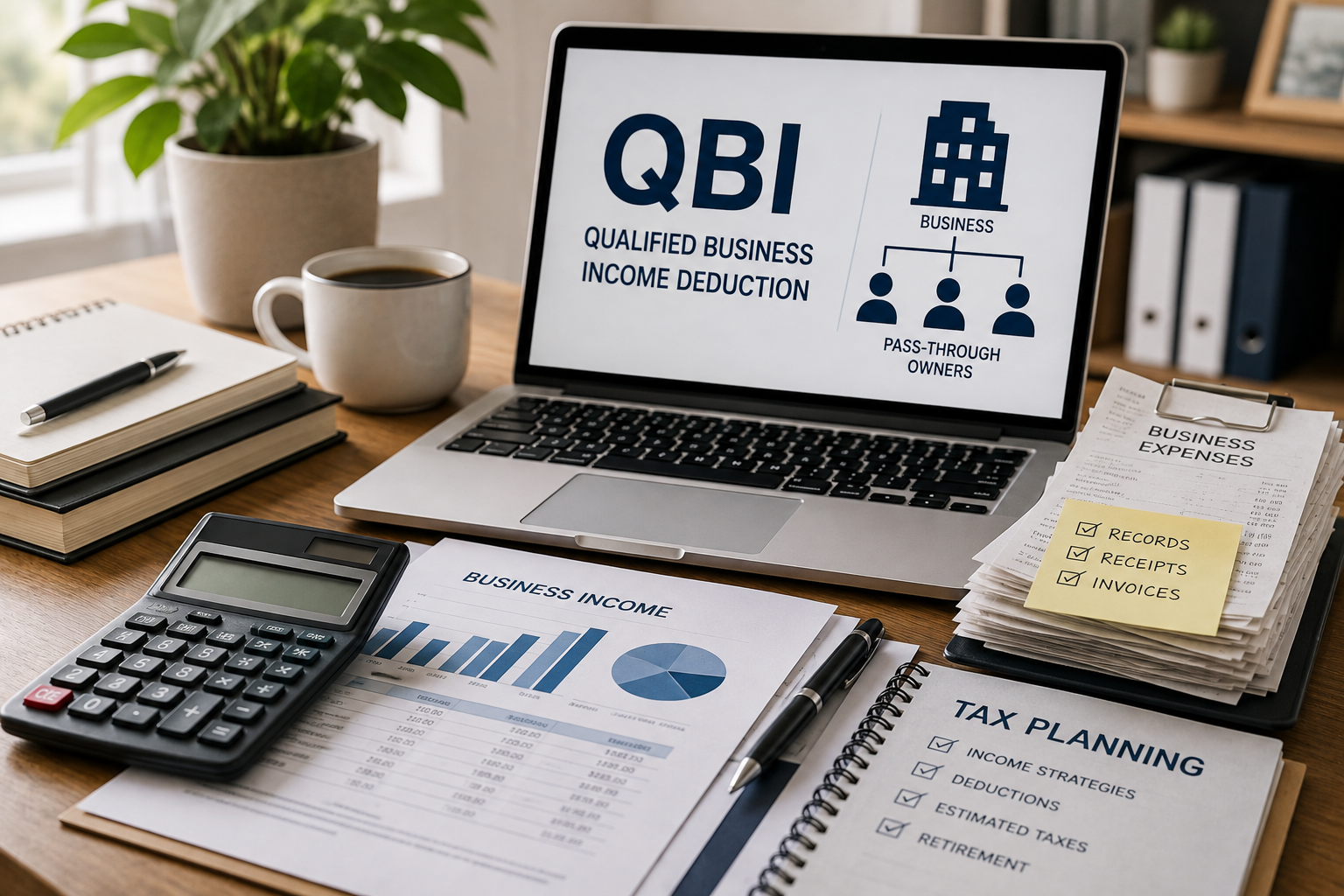
The Qualified Business Income Deduction can be a valuable tax break for eligible small business owners and self-employed taxpayers. If you operate a sole proprietorship or own an interest in a partnership, S corporation, or certain other pass-through businesses, you may be able to deduct up to 20% of your qualified business income (QBI) on your federal income tax return.
But the 20% figure isn’t automatic.
Your taxable income, type of business, wages paid by the business, qualified property, and other factors can affect how much of the deduction you can actually claim. That’s why understanding the basic rules before tax season can make a meaningful difference.
In this week’s Tax Tip Tuesday, we’re breaking down how the QBI deduction works and what business owners should know.
What Is the Qualified Business Income Deduction?
The Qualified Business Income Deduction, also known as the Section 199A deduction, generally allows eligible taxpayers to deduct up to 20% of qualified income generated by certain trades or businesses.
Unlike many business deductions, this deduction doesn’t directly reduce the income reported by the business itself. Instead, eligible owners generally calculate the deduction on their individual income tax returns.
Another important benefit is that you don’t have to itemize deductions to potentially qualify. The IRS explains that eligible taxpayers can take the QBI deduction whether they use the standard deduction or itemize. For additional details, review the IRS resource on the Qualified Business Income Deduction.
Which Businesses May Qualify for the QBI Deduction?
The deduction primarily applies to income from qualifying pass-through businesses.
That can include:
- Sole proprietorships
- Partnerships
- S corporations
- Certain trusts and estates
- Some qualifying rental real estate activities
A pass-through business generally doesn’t pay federal income tax at the entity level in the same manner as a C corporation. Instead, business income passes through to the owners, who report their respective shares on their individual returns.
C corporation income does not qualify, and wages you receive as an employee aren’t QBI.
For sole proprietors in particular, accurate Business Expense Deductions and good bookkeeping are important because properly determining the business’s net income is part of establishing the starting point for many tax calculations.
What Counts as Qualified Business Income?
Do not wait until filing season to reconstruct twelve months of spending. Create a simple Qualified business income generally represents the net amount of qualifying income, gain, deductions, and losses connected with a qualified U.S. trade or business.
Not everything a business owner receives necessarily counts as QBI.
For example, the IRS identifies several items that may be excluded from QBI calculations, including certain capital gains and losses, interest income not properly allocable to the business, reasonable compensation paid to an S corporation shareholder, and guaranteed payments made to partners for services.
This is one reason proper bookkeeping matters.
Accurately categorizing income and expenses throughout the year can make it much easier to determine your business income and identify potential deductions when it’s time to prepare your return. Our Business Expense Deductions article provides additional guidance on keeping the documentation needed to support legitimate business expenses.
Is the Qualified Business Income Deduction Always 20%?
No.
The phrase “up to 20%” is important.
The QBI deduction is subject to several limitations. Depending on a taxpayer’s circumstances, factors may include:
- Total taxable income
- Type of trade or business
- W-2 wages paid by the business
- Qualified property held by the business
- Net capital gain
- Income from multiple businesses
- Business losses
The IRS specifically notes that the deduction can be limited based on taxable income, the nature of the business, W-2 wages, and the unadjusted basis of certain qualified property.
In other words, simply multiplying business profit by 20% won’t necessarily produce the correct deduction.
Income Can Affect the Qualified Business Income Deduction
Income thresholds play an important role in calculating QBI for some taxpayers.
For tax year 2026, the IRS lists the Section 199A threshold at $403,500 for married couples filing jointly and $201,750 for most other returns. Above applicable thresholds, additional limitations and phase-in rules may affect the deduction.
This can become particularly important for owners of a Specified Service Trade or Business (SSTB), which may include certain businesses involving fields such as health, law, accounting, consulting, financial services, and other specified services.
Business owners approaching these income levels should consider tax planning before year-end rather than waiting until the return is being prepared.
How Do You Claim the QBI Deduction?
Many qualifying taxpayers calculate their deduction using IRS Form 8995, Qualified Business Income Deduction Simplified Computation.
More complicated situations may require Form 8995-A and its applicable schedules.
This is another reason proactive tax planning for small business owners can be valuable. Changes in business income, retirement contributions, deductible expenses, and other aspects of your tax situation can interact with your overall federal tax picture.
Understanding those relationships before December 31 provides more opportunities to plan than discovering them when the return is already being prepared.
Good Bookkeeping Supports Better Tax Planning
Your tax return is only as reliable as the records behind it.
Maintaining accurate books throughout the year gives you a clearer picture of your actual business income and makes it easier to identify legitimate expenses, prepare estimated tax payments, and evaluate potential tax-saving opportunities.
Business owners should consistently track:
- Gross business income
- Deductible expenses
- Payroll and W-2 wages
- Equipment and other business property
- Retirement plan contributions
- Health insurance expenses
- Business losses and carryforwards
- Owner compensation and distributions
For broader guidance, the IRS Tax Guide for Small Business provides information for sole proprietors on recordkeeping, business income, expenses, and federal tax responsibilities.
You can also review our Estimated Tax Payments and Business Expense Deductions resources for additional strategies that can help make tax planning more predictable throughout the year.
Qualified Business Income Deduction: The Bottom Line
The Qualified Business Income Deduction can potentially provide significant tax savings for eligible business owners, but the rules are more complicated than simply deducting 20% of your profit.
Business structure, taxable income, compensation, expenses, wages, property, and the nature of your business can all matter.
At Cheshier Tax Resolution, we believe proactive planning and accurate records give business owners a much better opportunity to understand their tax position before filing season arrives.
Know your numbers. Keep good records. And understand which tax provisions may apply to your business before making important financial decisions.
Frequently Asked Questions
What is the Qualified Business Income Deduction?
The Qualified Business Income Deduction is a federal tax deduction under Section 199A that may allow eligible taxpayers to deduct up to 20% of qualified business income, subject to applicable limitations.
Do sole proprietors qualify for the QBI deduction?
Potentially, yes. Qualified income from a sole proprietorship can be eligible for the deduction if the taxpayer and business otherwise satisfy the requirements.
Do S corporation owners qualify?
S corporation shareholders may potentially claim the deduction based on qualifying income passed through from the S corporation. However, reasonable compensation paid to the shareholder isn’t treated as QBI.
Can I claim QBI if I take the standard deduction?
Yes. The QBI deduction can potentially be claimed whether you take the standard deduction or itemize deductions.
Is the QBI deduction automatically 20%?
No. It is a deduction of up to 20%, and several limitations can reduce or eliminate the available deduction depending on the taxpayer’s circumstances.
Stay Connected
Stay connected with Cheshier Tax Resolution for updates on community involvement, tax law changes, and insights that help taxpayers stay compliant and informed – we invite you to subscribe to our monthly newsletter.
Our newsletter delivers:
- Updates on tax law changes
- Insights from real resolution cases
- Proactive planning strategies
- Important filing deadlines and compliance reminders
- Company announcements and celebrations